Inspector dossiers
Every Ofsted inspector's grading record against the national baseline, their patch on a map, and who they inspect with.
New Ofsted reports read within minutes of publication
Over twenty years of Ofsted reports, read line by line. See how each inspector grades against the national picture, decode the new report cards, and click through to the exact sentence behind every judgement.
No card No password Web, iPhone, iPad and Android


0 settings mapped

The data
Every published inspection report in England since 2005, for schools, early years, further education and children's social care. Updated as Ofsted publishes.
Ofsted reports read
Every page, every judgement
Inspectors profiled
Grading record vs national
Settings tracked
Schools, nurseries, homes, colleges
Years of history
From 2005 to this week
Live figures from the InspectorWho archive, refreshed hourly.
What you can uncover
Ofsted publishes reports one PDF at a time. InspectorWho reads them all, connects them, and shows you the patterns, the people and the evidence behind every grade.
Every Ofsted inspector's grading record against the national baseline, their patch on a map, and who they inspect with.
The new five-point Ofsted report cards broken out area by area, and compared with what came before.
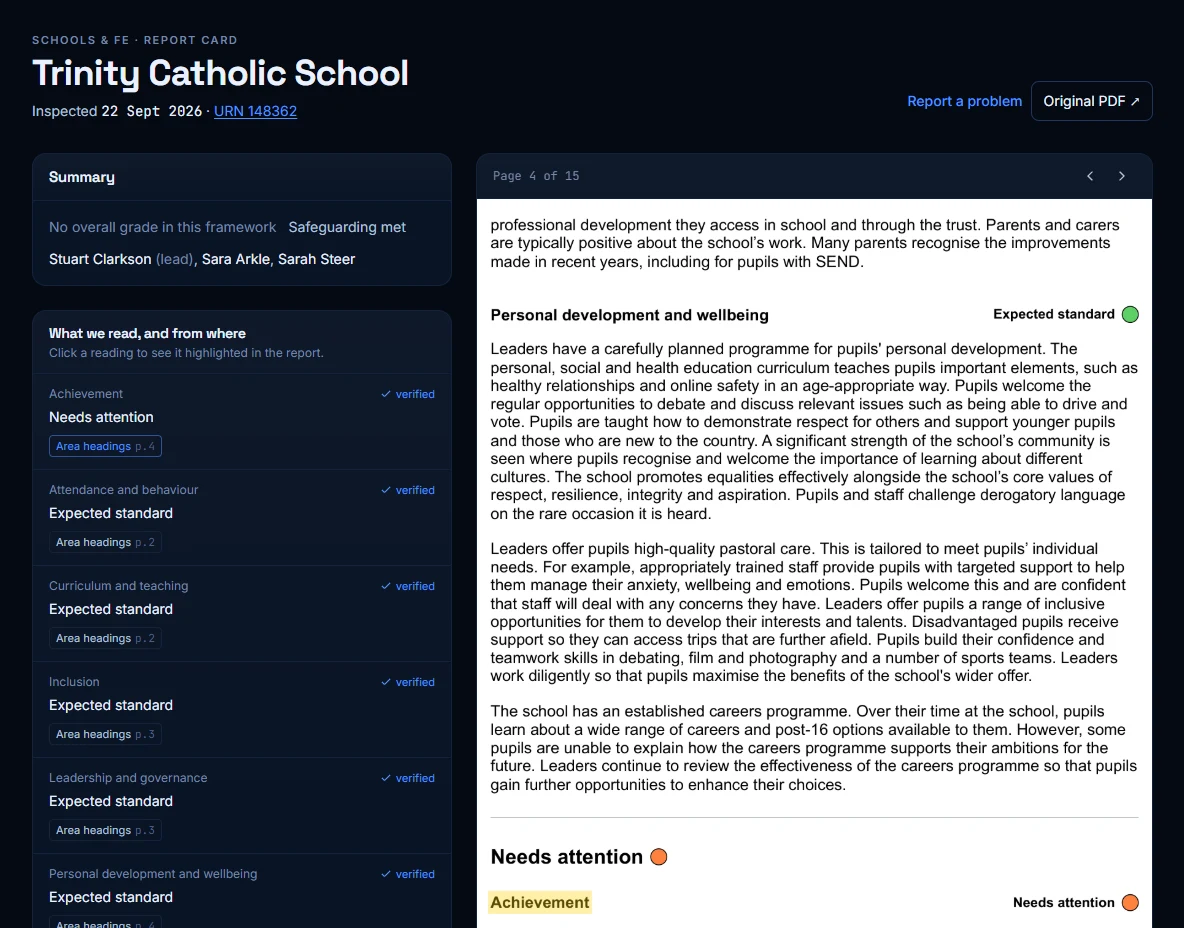
Each fact is read at least two independent ways. Click any grade to see the highlighted line on the original page.
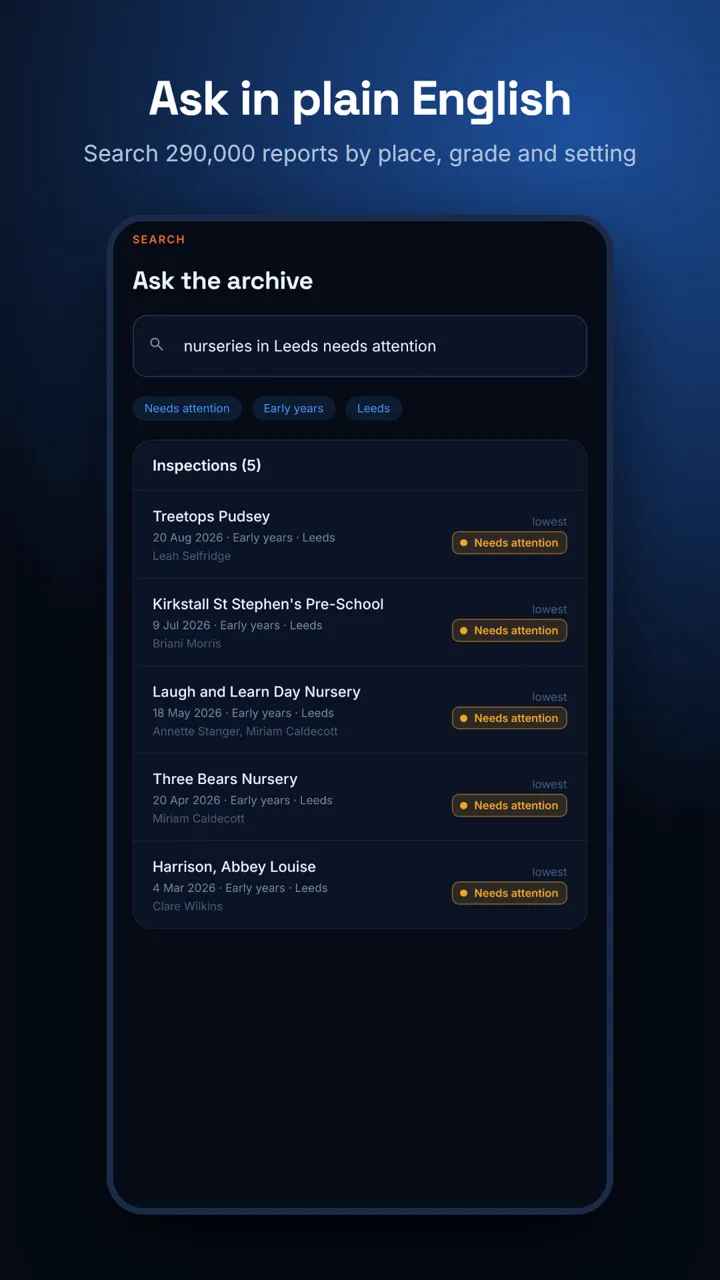
Search in plain English, like "inadequate nurseries in Leeds 2025". Places, grades, setting types and years are picked out of your words, and passages are matched by meaning, not just keywords.
How positive or critical a report reads, the topics it dwells on, and its strengths, concerns and next steps quoted with page links. Rule-based, no AI.
Grade trends by year for every remit, the first report card results, and local authority tables.
Found out who's inspecting? Get a printable briefing on that inspector: how their grades compare with national figures, what their reports dwell on, what they often ask settings to improve, and practical ways to prepare. Written by AI from their published record, with the numbers shown.
An estimate of when each setting is next likely to be inspected, from its last full inspection, the outcome and Ofsted's usual windows. Follow your setting, or a whole group, and see what's coming due.
Every setting page shows the ten nearest of the same kind, nurseries with nurseries and primaries with primaries, with their latest grades.
Every inspected setting in England on one map. Move, zoom and filter by sector and grade, and the list follows the map.
What's going well and what needs to improve, in a few lines, for any report.
Academy trusts, federations, nursery chains and care providers, with every setting they run and its latest grade.
Follow inspectors, settings, whole groups or an area (any setting within a few miles of a postcode or town) and get an email or a phone notification when a new report lands, or one round-up on Monday mornings.
The InspectorWho app for iPhone, iPad and Android, free on the App Store and Google Play: the daily briefing, search, map, Deep insight, inspector briefings, alerts, enquiries and tour booking, with the same account as the website.
Rate your inspection experience and compare notes with providers, staff and parents.
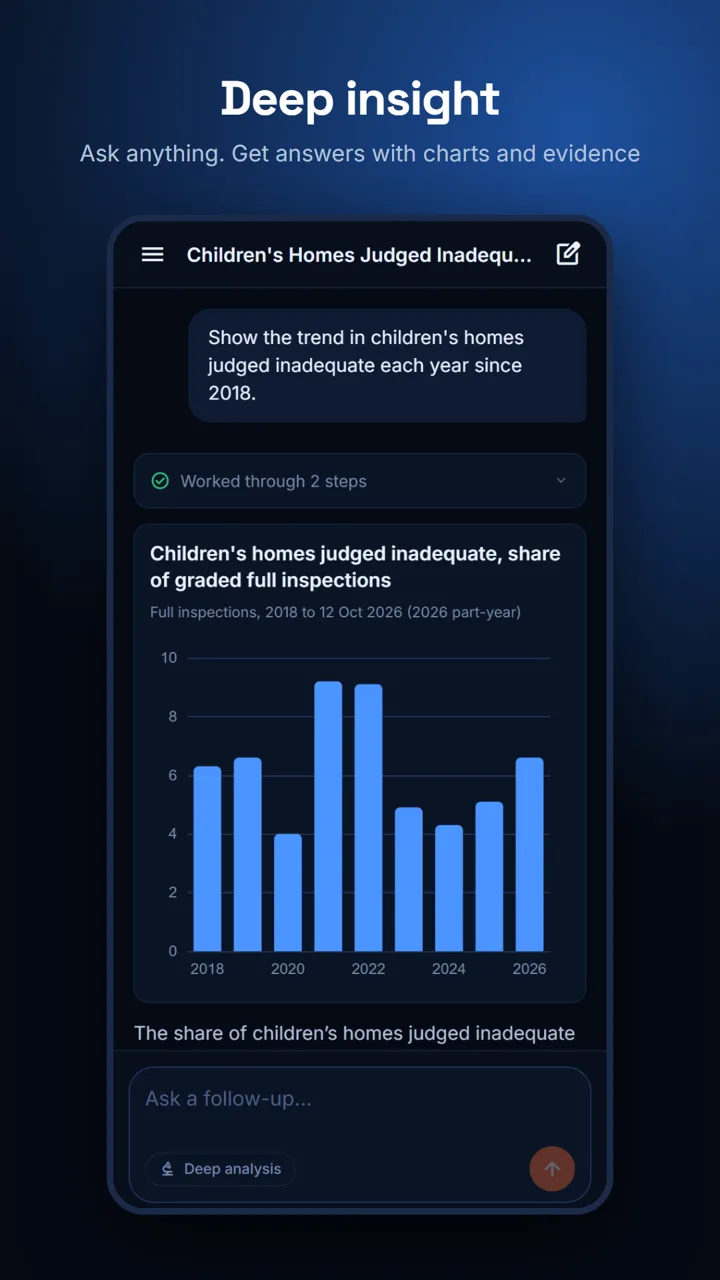
New: Deep insight
An AI analyst for the whole archive. Ask a question in plain English and get an answer with charts, sortable tables and links to the reports behind it, then download it as Excel, Word, PDF or CSV. It works across all 462,000+ reports and shows each step it took, so you can check its working.
Start with £1 of credits free. Then £4.99 a month for 50 credits, with top-ups if you need more; each answer uses a few, depending on how much work it takes.
New: for nurseries, schools and care providers
Families are already reading your Ofsted reports here. Claim your page for free to tell them what the reports don't, and turn their interest into enquiries and visits.
Run a nursery, school, children's home or a whole group? Claim it. A person at InspectorWho checks every claim, and Ofsted's reports and grades are never changed by one.
Add your website, opening hours, ages, funded places, session prices and photos, and notes for parents on the things they always ask about. Every change is checked before it goes live.
Families send an enquiry from your page and it goes to your team by email. Reply as normal: the answer goes straight back to them.
Add a reply beneath any of your Ofsted reports: what you've changed since, or context families should know. Ofsted's report itself is never altered.
Set the days and times, how long each tour takes, how many families per tour, how much notice you need and how far ahead people can book. Families get a confirmation, a calendar file and a reminder the day before.
Invite colleagues as owners, managers or staff. Groups can give each manager just the settings they look after, and manage every setting from one place.
Page views, clicks through to your website and enquiries, day by day, plus a badge with your latest Ofsted outcome for your own website.
Free. A person checks every claim, usually within a working day. Ofsted's reports and grades are never changed.
Take a look inside
Every judgement links to the exact line on the original Ofsted page, highlighted. Each one is marked verified when independent readings agree.
Ask the archive
Type a question in plain English. InspectorWho picks out the grade, setting type, place, date and report card area, then searches every report and every passage across 462,000+ inspections.
The app
The InspectorWho app for iPhone, iPad and Android, free on the App Store and Google Play: the daily briefing, search, map, Deep insight, inspector briefings, alerts, enquiries and tour booking, with the same account as the website.
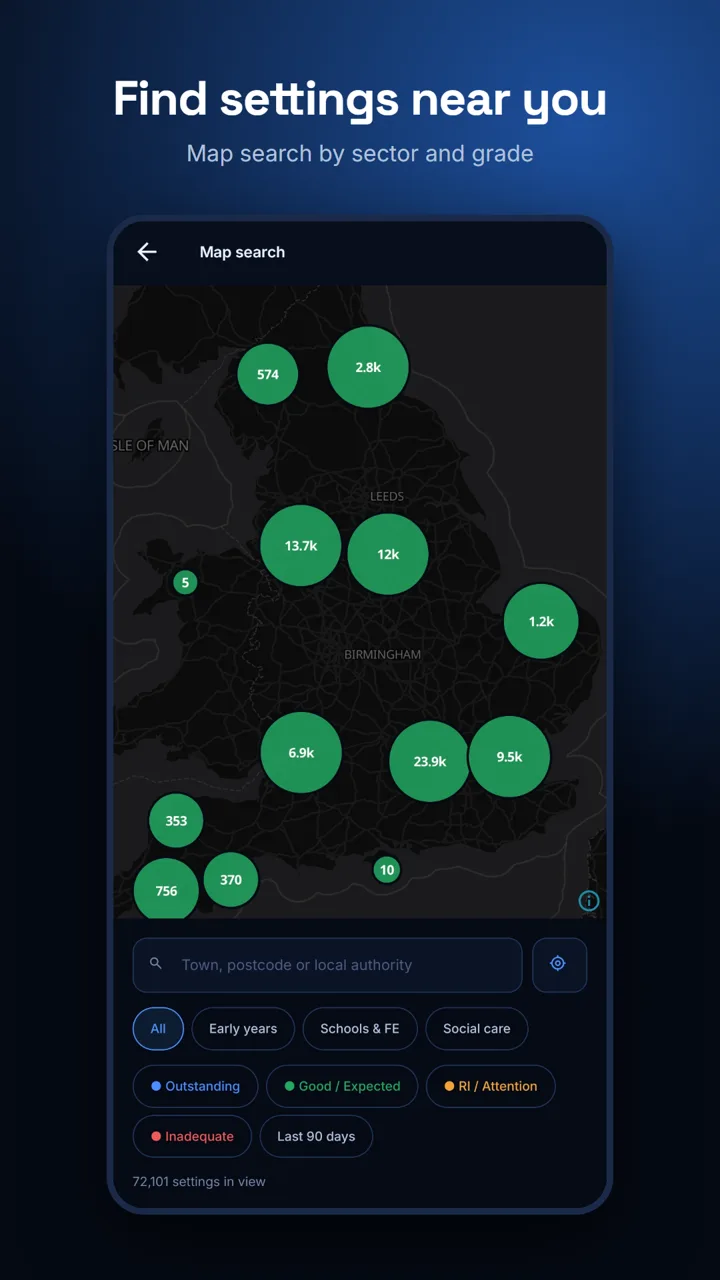
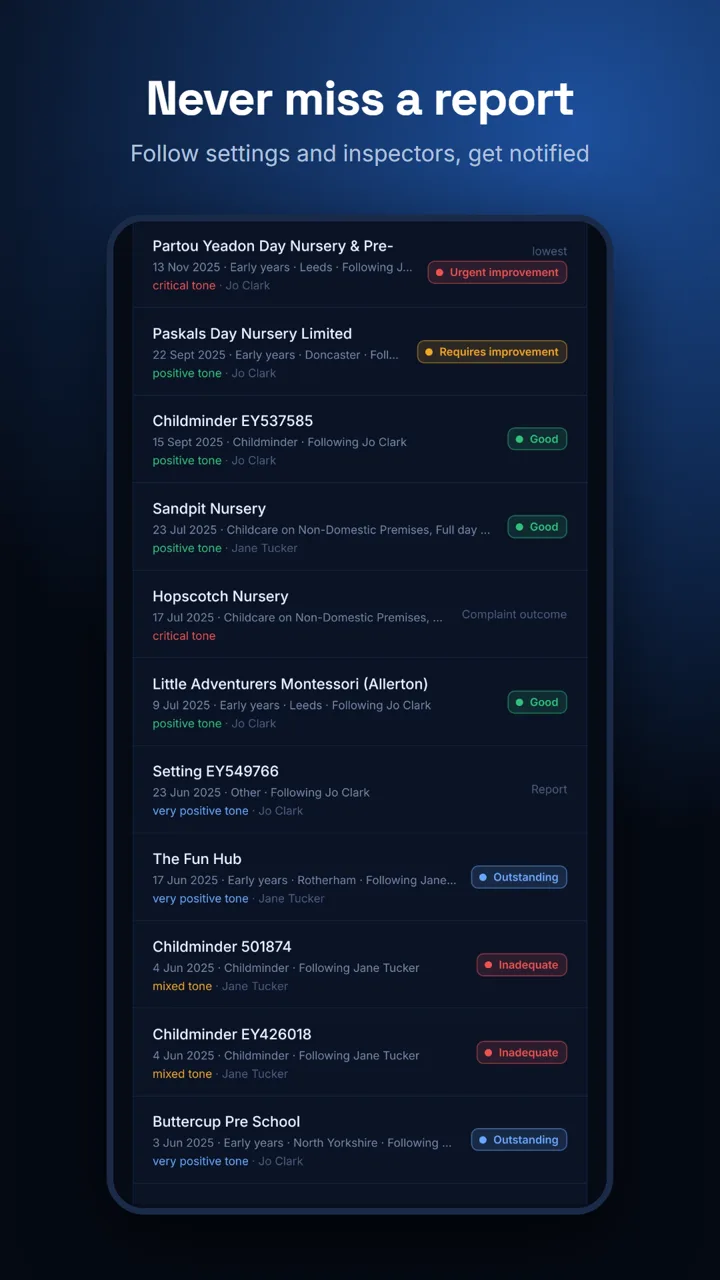
Free. Same account as the website. Notifications when a report you follow lands.
How it works
Inspection outcomes shape careers and businesses, so the numbers have to be right. Here's how every report gets from Ofsted's website to your screen.
An always-on watcher checks Ofsted for new reports every 15 minutes, and a continuous sweep of every setting's Ofsted page fills in older reports that were missed.
Each report is read by layout-aware rules. Grades, dates, inspectors and URNs are only accepted when independent readings agree.
Disagreements are flagged, not guessed. AI is used only to settle them, and people check the edge cases one fact at a time.
Every fact links to the exact line it came from on the original Ofsted page, so you can check it yourself.
Every fact links to the line it came from
Tone and themes measured with no AI
Built on public reports under the Open Government Licence
Who it's for
Whether you're preparing for your next visit, choosing a school or nursery, or researching the system itself.
Claim your nursery's page, add your prices and photos, take enquiries and tour bookings, and get a briefing on the inspector who's coming. See what's due and how settings like yours have been graded.
Read reports for childminders near you in minutes, not hours, and find out what inspectors praised and challenged.
Decode the new report cards, benchmark your trust against the national picture, and claim your group to manage every school's page with your own team.
Social care judgements, monitoring visits and assurance visits, all searchable alongside the inspectors who carried them out.
Look past the headline grade. See what a report actually says, compare nearby settings, read what the nursery or school says for itself, then send an enquiry or book a tour.
Twenty years of structured inspection data with an evidence link for every fact. Ask Deep insight for the chart or spreadsheet, spot the pattern, then cite the page.
“An Ofsted grade can make or break a setting. The evidence behind it should be open to everyone.”
FAQ
InspectorWho is a free platform that reads every published Ofsted inspection report in England, from 2005 to today, and turns them into searchable, structured data. You can look up any school, nursery, childminder, children's home or college, see every inspector's grading record against the national picture, and click through to the exact sentence behind every judgement.
Yes. Every report links to the inspectors named in it. Each inspector has a dossier showing how many inspections they have led, the grades they have given over the last five years compared with the national average for the same type of setting, where they inspect, who they inspect with and how their reports read. It is context, not a verdict on any individual.
Mostly, yes. Create an account with just your email address: we email you a sign-in code or link, with no password to remember. There is no card. Reports, settings, inspectors and national trends can be browsed without an account; joining lets you follow inspectors and settings, get an email when a new report about them is published, read plain-English summaries and inspector briefings, and join the discussion. Claiming your own setting's page is free too. Deep insight, the paid plan (£4.99 a month), adds the AI analyst with monthly credits, when each setting is next likely to be inspected, alerts for new reports near the places you choose, and the weekly digest and Monday round-up. Every member gets free credits to try the analyst.
Schools (including academies, independent and special schools), early years settings and childminders, further education colleges, and children's social care: children's homes, fostering and adoption agencies, supported accommodation, residential special and boarding schools, and local authority children's services. It includes graded, ungraded and monitoring inspections and the new report cards introduced from November 2025.
New reports are picked up automatically. InspectorWho checks Ofsted every 15 minutes, so a report is usually read and searchable within minutes of being published.
From November 2025, Ofsted replaced the single overall grade for schools with report cards. Each evaluation area, such as inclusion, curriculum and teaching, achievement, attendance and behaviour, personal development and wellbeing, and leadership and governance, is graded on a five-point scale: exceptional, strong standard, expected standard, needs attention or urgent improvement. Safeguarding is judged separately as met or not met. InspectorWho breaks every report card out area by area and compares it with the setting's previous inspection and the national picture.
Every key fact (the URN, inspection date, grades and inspectors) is read from the original PDF by at least two independent methods and is only accepted when they agree. Disagreements are flagged rather than guessed, settled with AI as a tie-breaker, and reviewed by people. Every fact links to the highlighted line in the original report so you can check it yourself.
Carefully, and only where it helps. Grades are extracted by rules, and tone, themes, strengths and next steps are calculated from Ofsted's own language with no AI involved. AI is used to settle facts where independent readings disagree, to write optional plain-English summaries of a report, and to power Deep insight, which answers your questions by querying the structured data and shows its working, so every figure can be traced back to the reports.
Deep insight is an AI analyst built into InspectorWho. Ask a question such as "Which local authorities have the highest share of nurseries graded below good since 2023?" and it queries every report, then answers with charts, sortable tables and diagrams, links to the reports behind the numbers, and downloads in Excel, Word, PDF or CSV. You can also connect it to your own AI assistant, such as Claude or Copilot, with a personal access token. It protects private individuals: childminders are never named and locations are rounded. Every member gets £1 of credits free to try it, then it's £4.99 a month for 50 credits, with top-ups for members on the plan. Each answer uses a few credits depending on how much work it takes.
Yes. The InspectorWho app is free for iPhone and iPad on the App Store, and for Android on Google Play. It has the daily briefing, plain-English search, map search, every report and inspector, Deep insight, and notifications when settings or inspectors you follow get a new report. It uses the same account as the website.
Yes. Anyone who runs a setting, or a group such as a nursery chain or academy trust, can claim its page for free. A person at InspectorWho checks each claim, usually within a working day. Once approved you can add your website, contact details, opening hours, funded places, session prices, photos and notes for parents, take enquiries and tour bookings, reply to your Ofsted reports, and invite colleagues as owners, managers or staff. Everything you add is checked before it appears, and Ofsted's reports and grades are always shown exactly as published.
On a setting that has claimed its page, families can send an enquiry or book a tour. Enquiries are emailed to the setting's team, who reply directly. Tours are booked into the times the setting offers: the family gets a confirmation with a calendar file and a reminder the day before, and either side can cancel. InspectorWho only passes details on; we keep a copy for 12 months to deal with any problems and never use it for marketing.
Each setting page shows an estimate based on its last full inspection, the outcome and Ofsted's usual timings: for example within 12 months of a Requires improvement for early years, roughly every four years for schools, and at least once a year for children's homes. It is an estimate only; Ofsted can inspect sooner, for example after a concern. Follow your setting and the Monday round-up tells you when inspections are coming due.
A short, printable "what to expect" for a named inspector, written by AI from their published record: how their grades compare with national figures for the same kind of setting, the themes their reports dwell on, what they most often ask settings to improve, and practical preparation points. It describes patterns in a public record, gives the numbers behind them, and never predicts the outcome of an inspection or comments on the inspector as a person.
No. InspectorWho is independent and is built on public Ofsted reports published under the Open Government Licence v3.0. It is an Early Tree product.
Yes. Members can rate their experience of an inspection and join the discussion on inspector and setting pages, choosing whether they are a provider, member of staff, parent or carer, inspector, researcher or something else. Discussions are moderated.
462,000+ reports, 17,000+ inspectors and 131,000+ settings, waiting to be investigated. Create an account in seconds with just your email.